Glock 45 vs. Glock 17: Which Glock Makes More Sense for Carry, Duty, and Everyday Shooting?
For many years, the Glock 17 represented the answer to a remarkably simple question.
If someone asked which full-size polymer pistol could serve equally well as a duty gun, a home-defense pistol, a training handgun, or simply something that would run reliably for decades with minimal maintenance, the Glock 17 almost inevitably entered the conversation. It wasn't necessarily the most refined handgun on the market, nor the most elegant, but it established a reputation for dependability that eventually became the standard against which virtually every modern striker-fired pistol would be measured.
Then Glock introduced the Glock 45.
To anyone unfamiliar with the company's naming conventions, the model designation suggested an entirely different caliber. In reality, the Glock 45 remained chambered in 9mm and presented a much more interesting idea. Rather than replacing the Glock 17, it combined the full-size grip of the larger pistol with the shorter slide assembly of the Glock 19.
The Glock 45 and Glock 17 share the same full-size grip and magazine capacity, but the Glock 45 uses a shorter Glock 19-length slide while the Glock 17 retains its traditional full-size slide and barrel. The Glock 45 generally feels quicker to handle and slightly more comfortable to carry, while the Glock 17 offers a longer sight radius, a little more muzzle weight, and slightly higher velocity. Neither is universally better. The right choice depends on how you plan to use the pistol.
On paper, the difference sounded almost insignificant.
In practice, it changed the personality of the pistol far more than most shooters expected.
That's why comparing these two handguns is considerably more interesting than lining up dimensions in a specification table.
The Glock 45 wasn't designed because the Glock 17 had become obsolete.
It exists because Glock recognized that many shooters had quietly arrived at the same conclusion after years of carrying service pistols. They appreciated the control offered by a full-size grip but weren't entirely convinced they needed a full-length slide to enjoy those benefits.
The Glock 45 became the company's answer to that observation.
Understanding that design philosophy makes the rest of the comparison much easier.
You're not choosing between a large pistol and a small one.
You're choosing between two remarkably similar handguns that simply distribute their size in different ways.
The Difference Isn't What Most Shooters Think
Ask someone who's relatively new to handguns what separates the Glock 45 from the Glock 17, and the answer is often predictable.
"The Glock 17 is bigger."
Technically, that's true.
Practically, it's incomplete.
Both pistols share the same full-size grip frame. They accept the same magazines, fill the hand in almost exactly the same way, and present essentially identical ergonomics when establishing a firing grip. Pick up either handgun without looking at the slide, and most shooters would struggle to distinguish them purely by feel.
That's important because the grip determines much of how a pistol shoots.
A full firing grip allows better recoil control, faster follow-up shots, and more consistent presentations from the holster. It's one reason so many shooters who spend time with compact pistols eventually migrate back toward full-size frames if concealment isn't their highest priority.
Where the pistols begin to diverge is forward of the trigger guard.
The Glock 17 carries a longer barrel, longer slide, and correspondingly longer sight radius. The Glock 45 shortens all of those dimensions while leaving the grip untouched.
That sounds like a subtle engineering decision.
It actually influences almost every aspect of how the pistol feels during use.
The shorter slide changes the balance point of the handgun. The center of gravity shifts slightly rearward, making the Glock 45 feel a bit more lively in the hands. Draws from the holster feel marginally quicker because less slide has to clear the holster before the pistol rotates toward the target. Transitioning between multiple targets often feels just a little faster because there's less mass moving at the front of the gun.
None of those differences are dramatic.
That's perhaps the most important point.
Shooters expecting the Glock 45 to behave like an entirely different handgun are usually surprised by how familiar it feels. Likewise, longtime Glock 17 owners rarely struggle when picking up the newer pistol because the grip, trigger, and overall manual of arms remain virtually unchanged.
The differences reveal themselves gradually, not immediately.
Our complete Glock 45 MOS review takes a closer look at how the full-size grip, compact-length slide, optics system, and 17-round capacity work together outside a direct comparison.
Where the Longer Slide Still Has an Advantage
The modern shooting world occasionally develops the habit of treating newer designs as though they automatically replace older ones.
The Glock 17 proves that isn't always true.
There's a reason so many law enforcement agencies, military organizations, and professional instructors continue using the full-size pistol decades after its introduction.
Longer slides offer genuine advantages.
The first is balance.
While some shooters describe the Glock 45 as quicker handling, others appreciate the steadier feel of the Glock 17. The additional weight forward of the shooter's hands gives the pistol a planted quality during deliberate shooting. It settles naturally into the target and tracks smoothly through recoil, characteristics that become increasingly noticeable during longer strings of fire or more precise shooting at extended distances.
The longer barrel also provides a modest increase in muzzle velocity.
No one should expect dramatic ballistic differences from an extra half-inch of barrel, but defensive ammunition generally performs best when fired within the velocity window for which it was designed. The Glock 17 offers a slight advantage in that regard, although it's one measured in percentages rather than dramatic leaps.
Perhaps more significant is the sight radius.
Iron sights remain the primary aiming system for many shooters, and additional distance between the front and rear sights makes small alignment errors easier to detect. That doesn't make the Glock 17 inherently more accurate—the mechanical accuracy of both pistols is excellent—but it can make precise shooting feel a bit more forgiving, particularly for newer shooters still refining their fundamentals.
These are the kinds of advantages that accumulate quietly.
None of them individually justify choosing one pistol over another.
Together, however, they explain why the Glock 17 continues to occupy such an important place despite the popularity of newer designs.
The complete Glock 17 Gen 5 review provides additional context on the traditional full-size Glock’s handling, performance, upgrades, and suitability for duty, defense, and range use.
The Glock 45 Was Built for the Way Many People Actually Carry
One of the more persistent myths surrounding concealed carry is that shorter slides automatically make pistols dramatically easier to conceal.
Experienced carriers know the story is more complicated than that.
When a pistol prints beneath clothing, it's almost always the grip revealing itself—not the slide.
The grip sits above the beltline where clothing drapes naturally, while the slide spends most of its time inside the pants. That's why a Glock 19 can occasionally prove more difficult to conceal than a slim single-stack pistol despite having a shorter slide. Grip height matters.
Since the Glock 45 and Glock 17 share essentially the same grip, neither gains a dramatic advantage in terms of concealment.
Where the Glock 45 begins to distinguish itself is comfort.
The shorter slide extends less deeply inside the waistband, making the pistol feel slightly more accommodating when sitting for long periods, driving, or bending throughout the day. Those differences become surprisingly noticeable for people who carry every day because comfort isn't measured during a five-minute fitting at the gun store.
It's measured over ten or twelve hours.
That philosophy helps explain why the Glock 45 found such an enthusiastic audience among both law enforcement officers and private citizens.
Many shooters weren't asking for a smaller grip.
They simply wanted the handling characteristics of a compact slide while preserving the confidence and control that come with a full-size frame.
This Glock 17 vs. Glock 19 comparison helps explain the two established Glock configurations that contributed to the Glock 45’s crossover design.
That's exactly what Glock built.
Helpful resources while comparing the two platforms include:
-
https://www.cyasupply.com/blogs/articles/best-glock-for-concealed-carry
-
https://www.cyasupply.com/blogs/articles/how-to-choose-a-concealed-carry-holster
-
https://www.cyasupply.com/blogs/articles/appendix-carry-vs-strong-side-carry
Choosing between these pistols ultimately becomes less about measurements and more about priorities. Both are exceptionally capable service pistols. The question is whether your priorities align more closely with the traditional strengths of the Glock 17 or the slightly more compact handling characteristics of the Glock 45.
Living With the Pistols Is Different Than Shooting Them
One of the shortcomings of many handgun comparisons is that they end at the firing line.
A few five-shot groups are fired from a bench, recoil is discussed for a paragraph or two, and someone declares a winner before the pistols have ever been worn on a belt, carried through a workday, or taken to a training class where several hundred rounds reveal characteristics impossible to notice during a brief range session.
That's unfortunate because the differences between the Glock 45 and Glock 17 become much more interesting after several months of ownership than they do during the first box of ammunition.
The Glock 17 settles into the role it has occupied for decades.
It feels substantial without becoming cumbersome. The longer slide gives the pistol a steady rhythm during recoil, and there is something reassuring about the way it tracks through repeated shots. It's difficult to describe until you've spent meaningful time behind one, but the Glock 17 has always possessed a certain predictability. It returns from recoil the same way every time, transitions smoothly between targets, and seems almost indifferent to how many rounds have already passed through it.
That predictability is one reason so many instructors still recommend it to newer shooters. The pistol asks very little of the shooter beyond good fundamentals. It rewards consistency without demanding constant attention.
The Glock 45 approaches the same task from a slightly different direction.
The shorter slide gives the pistol a lighter feel at the muzzle. Some shooters describe it as more responsive. Others say it feels quicker when driving the gun between multiple targets or clearing the holster. Neither description is wrong, although neither tells the whole story.
The difference is subtle enough that no experienced shooter would suddenly perform at a dramatically different level simply by changing pistols.
Instead, it's something you gradually begin to appreciate after enough repetitions.
If the Glock 17 feels composed, the Glock 45 feels agile.
That's probably the simplest way to describe it.
Shooters primarily concerned with daily concealment should compare the best Glock models for concealed carry, since both the Glock 45 and Glock 17 retain a full-size grip that may be harder to hide than smaller alternatives.
Duty, Home Defense, and Why Neither Pistol Is the Wrong Choice
Perhaps the strongest compliment either pistol can receive is that choosing between them often comes down to personal preference rather than obvious shortcomings.
For duty use, either handgun performs exceptionally well.
Law enforcement officers appreciate the full-size grip because it remains controllable under stress while accommodating gloves and larger hands without difficulty. Magazine capacity is identical, accessory support is nearly limitless, and both pistols have earned reputations for reliability that have been tested under conditions far more demanding than the average civilian owner is ever likely to encounter.
The decision usually comes down to handling.
Officers who spend long hours in patrol cars sometimes prefer the Glock 45 because the slightly shorter slide feels marginally less intrusive when seated for extended periods. Others appreciate the traditional balance of the Glock 17 and see no reason to abandon a platform that has served generations of officers remarkably well.
Home defense presents an even smaller distinction.
Inside a residence, neither pistol suffers from a meaningful disadvantage. Both accept weapon-mounted lights, both handle red-dot optics extremely well in their MOS configurations, and both provide enough capacity that few owners will ever feel under-equipped. Reliability, familiarity, and regular practice matter far more than the half-inch separating the slides.
That's worth remembering because it's easy to become distracted by specifications that rarely influence practical outcomes.
A homeowner who has trained extensively with a Glock 17 is almost certainly better prepared than someone who purchased a Glock 45 last week simply because another article declared it superior.
The pistol matters.
Experience matters considerably more.
For readers sorting through Glock’s sometimes-confusing numbering system, this guide to Glock models and sizes explained places the Glock 17 and Glock 45 within the broader lineup.
Optics, Lights, Magazines, and the Advantages of Staying Within the Glock Ecosystem
One reason Glock pistols continue dominating both civilian and professional markets is that the surrounding ecosystem has become almost impossible to rival.
Need magazines?
They're everywhere.
Want a weapon light?
Every major manufacturer builds one around Glock dimensions.
Interested in optics?
The MOS variants of both pistols accommodate modern miniature red dots with remarkable ease, and aftermarket support remains extensive regardless of which direction you decide to take the pistol.
That flexibility simplifies ownership.
Both the Glock 45 and Glock 17 share standard full-size Glock magazines, allowing owners to build a collection of magazines that works across multiple pistols. Anyone already invested in the Glock platform immediately benefits from that compatibility, particularly if a Glock 19, Glock 47, or other double-stack 9mm already occupies the safe.
Accessory selection follows the same pattern.
Weapon lights, sights, magazine pouches, replacement parts, and training equipment are readily available because manufacturers have spent decades supporting Glock pistols. Whether you're building a home-defense handgun with a compact weapon light and optic or simply purchasing additional magazines for range use, finding compatible equipment rarely becomes difficult.
That said, it's worth remembering that compatibility doesn't eliminate the need for thoughtful testing.
Installing an optic, replacing sights, adding a compensator, or changing internal components should always be followed by meaningful range time before the pistol returns to defensive use. Glock's reputation for reliability wasn't earned through assumptions, and neither should yours be.
Choosing Between Them Is Really Choosing Between Philosophies
The temptation with every comparison article is to declare a winner.
That's satisfying for headlines.
It rarely reflects reality.
The Glock 17 represents the traditional philosophy of a service pistol. It embraces the advantages of a full-length slide, longer sight radius, and balanced recoil characteristics while accepting the modest increase in overall size that accompanies those strengths. For many shooters, particularly those purchasing their first full-size handgun, it remains one of the easiest pistols to recommend because it simply does so many things exceptionally well.
The Glock 45 reflects a more modern interpretation of the same idea.
Rather than asking shooters to compromise with a shorter grip, Glock shortened the slide instead. The result is a pistol that preserves virtually everything people appreciate about a full-size handgun while making it feel slightly handier during everyday carry and dynamic shooting.
Neither philosophy invalidates the other.
If anything, the continued popularity of both pistols demonstrates that shooters value different characteristics even when their intended use appears remarkably similar.
The better question isn't which Glock is objectively superior.
It's which one better complements the way you actually shoot, carry, and train.
The Glock 45 vs. Glock 19X comparison provides additional context on Glock’s crossover concept and the differences between two pistols built around a compact slide and full-size grip.
Final Thoughts
The Glock 17 has spent more than four decades proving why simple, durable service pistols continue earning loyal followings long after newer designs appear. It remains one of the easiest handguns in the world to recommend because it balances reliability, shootability, and practicality with very few compromises. The Glock 45 doesn't diminish that legacy. Instead, it offers a thoughtful variation on the same theme by shortening the slide while preserving the full-size grip that so many shooters already trusted.
That seemingly modest change explains why both pistols continue attracting devoted owners. Some shooters appreciate the planted feel, longer sight radius, and traditional balance of the Glock 17. Others discover that the Glock 45's slightly shorter front end makes everyday carry more comfortable and transitions between targets feel just a bit quicker. Neither experience is more valid than the other because both pistols remain exceptionally capable service handguns.
Ultimately, choosing between them has less to do with dimensions than with priorities. If your pistol will spend most of its life on the range, beside the bed, or riding in a duty holster, the Glock 17 remains as compelling today as it was decades ago. If you want many of those same strengths packaged in a form that feels a little more accommodating during everyday carry, the Glock 45 makes a remarkably persuasive case.
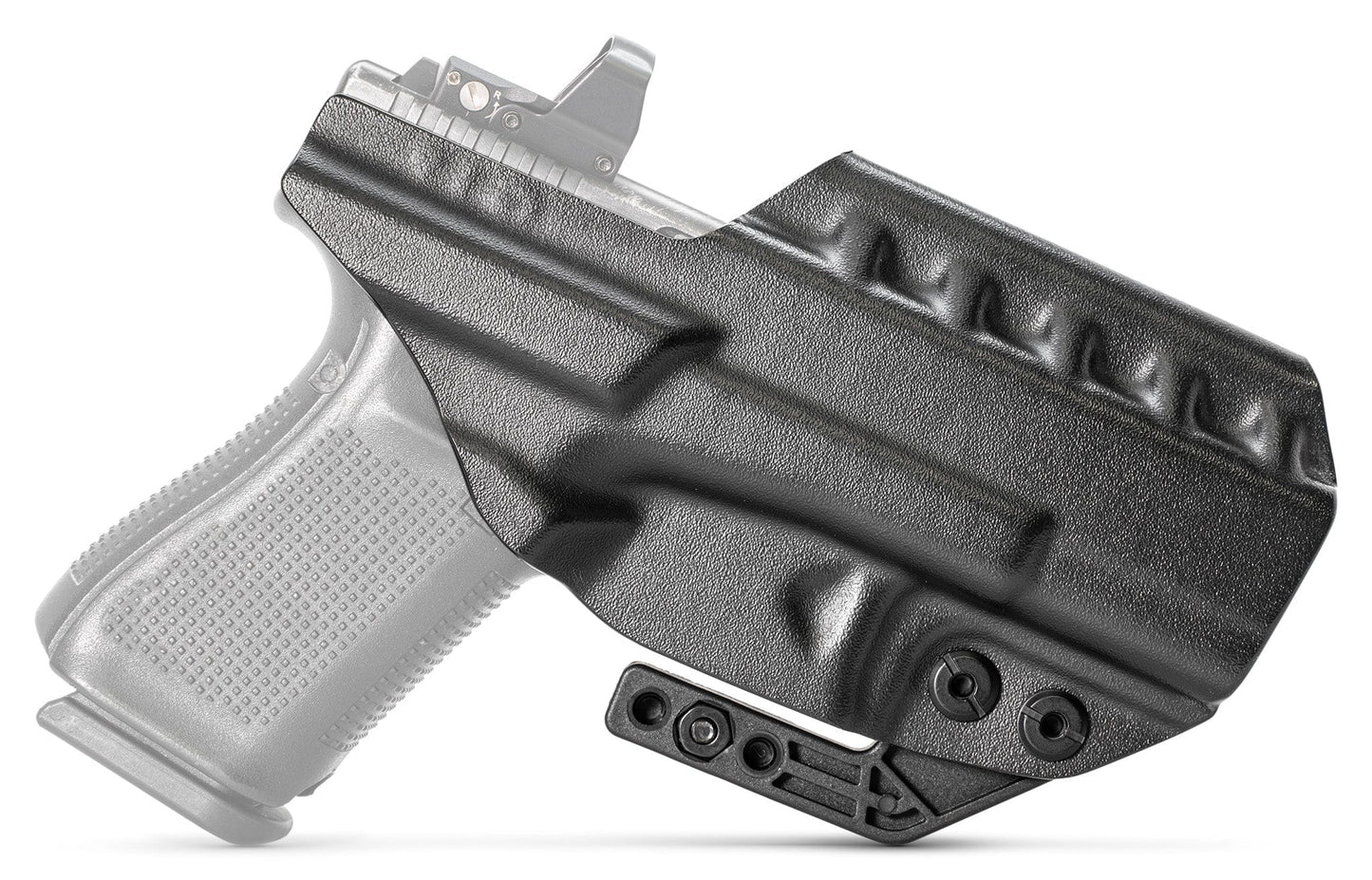
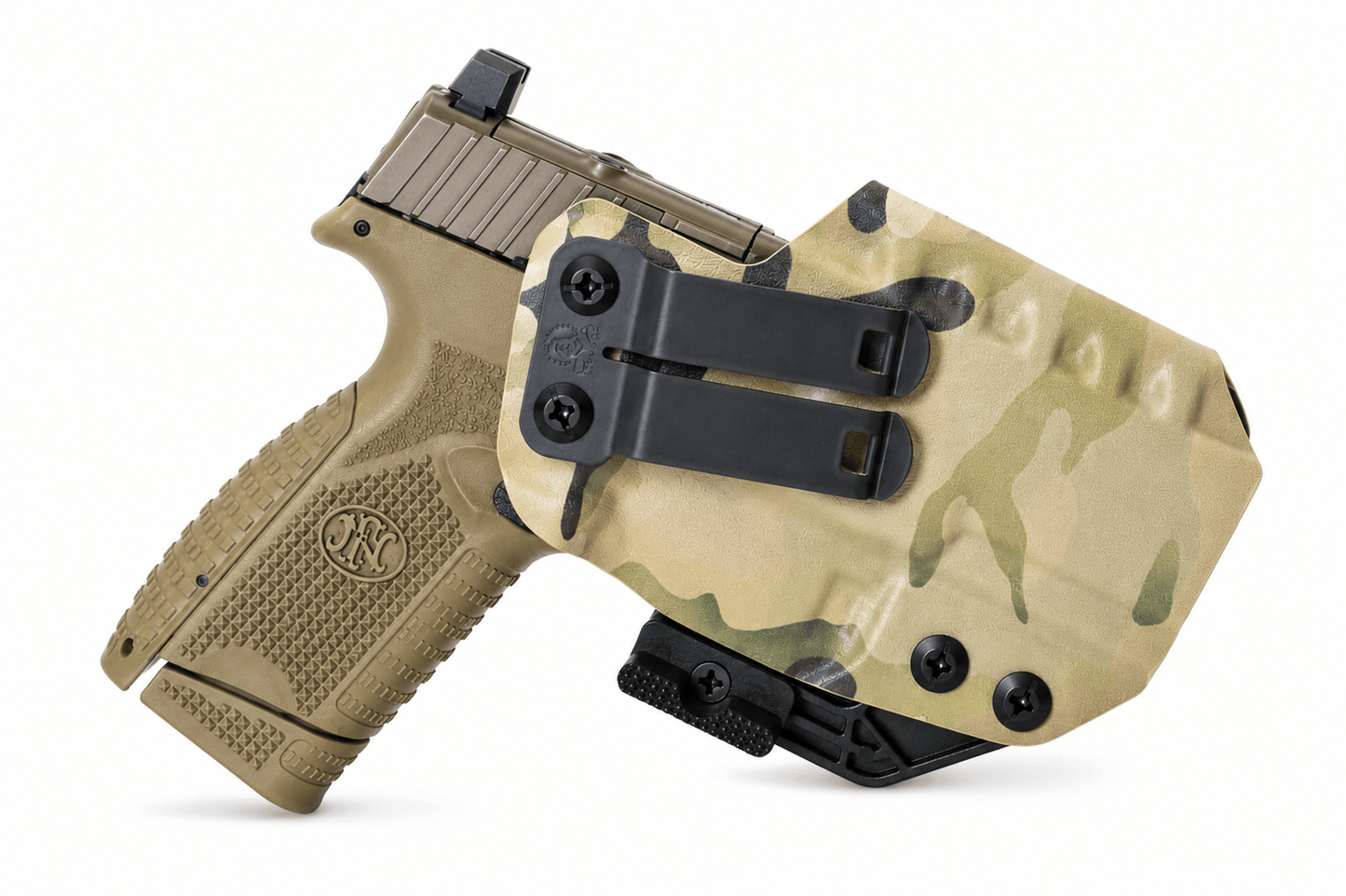
Whichever model you choose, complete the system with a holster designed specifically for that pistol. Although the grips are nearly identical, the difference in slide length means each handgun deserves a model-specific holster that provides secure retention, full trigger guard coverage, optic clearance where needed, and the kind of comfort that encourages consistent carry. A quality holster doesn't simply hold the gun—it allows you to take advantage of everything that made you choose it in the first place.
Frequently Asked Questions
What is the main difference between the Glock 45 and Glock 17?
The Glock 45 combines a full-size Glock 17 grip with the shorter slide and barrel length of the Glock 19. The Glock 17 retains a traditional full-size slide and barrel.
Is the Glock 45 easier to conceal?
Only slightly. Both pistols share the same full-size grip, which is usually the part most likely to print beneath clothing. The shorter slide primarily improves comfort while carrying inside the waistband.
Does the Glock 17 shoot more accurately?
Both pistols are mechanically very accurate. The Glock 17's longer sight radius may make precise shooting slightly easier for some shooters using iron sights.
Which pistol has less recoil?
Recoil is very similar. The Glock 17's additional slide length and forward weight give it a slightly steadier recoil impulse, while the Glock 45 often feels quicker during transitions.
Are Glock 17 and Glock 45 magazines interchangeable?
Yes. Both pistols use standard full-size double-stack Glock 9mm magazines.
Should I buy the MOS version?
If you plan to use a pistol-mounted optic, the MOS versions are generally worth considering because they simplify future optic installation.
Do they use the same holster?
No. Although the grips are nearly identical, the difference in slide length means each pistol should use a holster designed specifically for that model.
Which is better for home defense?
Both perform exceptionally well. Your familiarity with the pistol and consistent training matter far more than the small dimensional differences.
Which is better for first-time Glock owners?
Either is an excellent choice. Shooters who value the traditional feel of a full-size service pistol often gravitate toward the Glock 17, while those interested in eventual concealed carry frequently appreciate the Glock 45's slightly shorter slide.
Is the Glock 45 replacing the Glock 17?
No. The Glock 45 complements the Glock 17 rather than replacing it. Both remain widely used for professional, defensive, and recreational shooting.

Justin Hunold
Wilderness/Outdoors Expert
Justin Hunold is a seasoned outdoor writer and content specialist with CYA Supply. Justin's expertise lies in crafting engaging and informative content that resonates with many audiences, and provides a wealth of knowledge and advice to assist readers of all skill levels.